

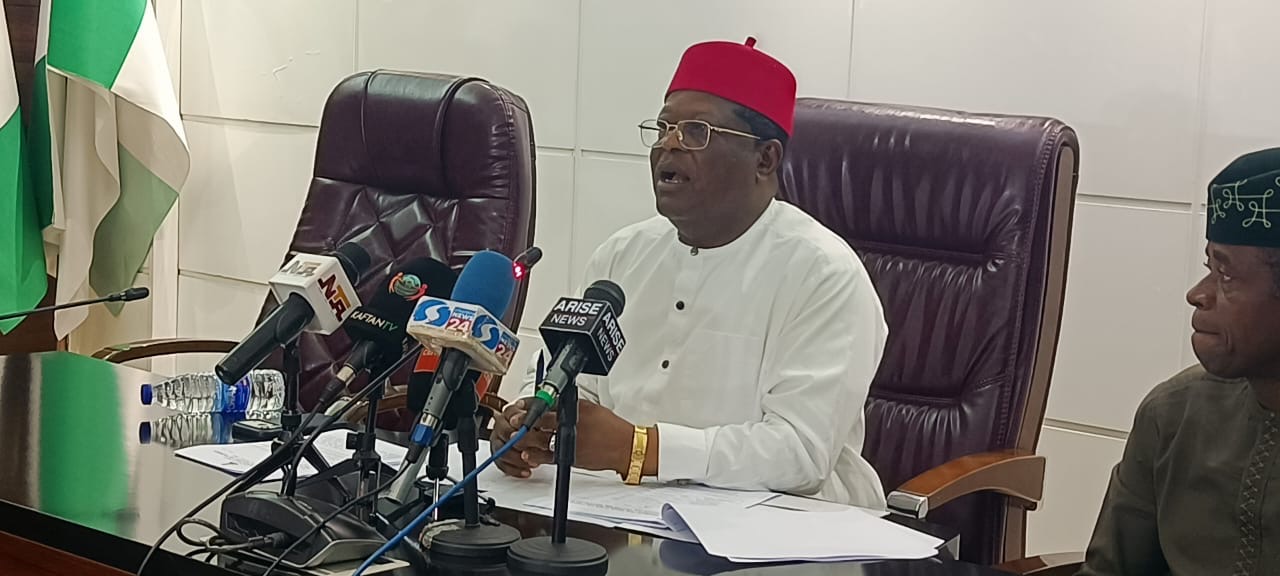
Umahi Defends Tinubu’s Highway Agenda, Says Legacy Road Projects Are Transforming Nigeria
Minister of Works, Senator David Umahi, has defended President Bola Ahmed Tinubu’s ambitious highway development programme, describing it as a transformational investment designed to strengthen national connectivity, stimulate economic growth, and accelerate regional development.
Speaking during a media briefing in Abuja, Umahi said the administration’s Legacy Highway Programme is creating an integrated road network that links Nigeria’s six geopolitical zones while opening new opportunities for trade, investment, and mobility.
The minister disclosed that construction is actively progressing on the 750-kilometre Lagos-Calabar Coastal Highway, with more than 360 kilometres already under construction. He noted that the project, now officially named the President Bola Ahmed Tinubu Coastal Highway, remains one of the most significant infrastructure initiatives in the country.
Umahi also highlighted progress on other flagship projects, including the Sokoto-Badagry Super Highway, the Trans-Sahara Highway, and the Akwanga-Jos-Bauchi-Gombe-Biu-Maiduguri Corridor, alongside newly approved strategic roads in the South-East.
Responding to criticism surrounding the Lagos-Calabar Coastal Highway, the minister dismissed claims that the project is responsible for flooding in parts of Lagos, insisting that engineering assessments show the highway is helping to protect coastal communities from ocean surge and seawater encroachment.
He further defended the procurement process used for the project, stating that all approvals were obtained from relevant government authorities and that international financiers have demonstrated strong confidence in its viability.
According to Umahi, the administration is also prioritising climate-resilient infrastructure through reinforced concrete pavements, improved drainage systems, and flood-control measures, while creating opportunities for young Nigerian engineers to gain practical experience on major construction projects.
He maintained that President Tinubu’s infrastructure drive is not only about building roads but also about laying the foundation for long-term economic growth, improved connectivity, and sustainable national development.
“These projects are long-term investments in Nigeria’s future. Their impact will be measured by the economic opportunities they create and the connectivity they deliver across the country,” Umahi said.
